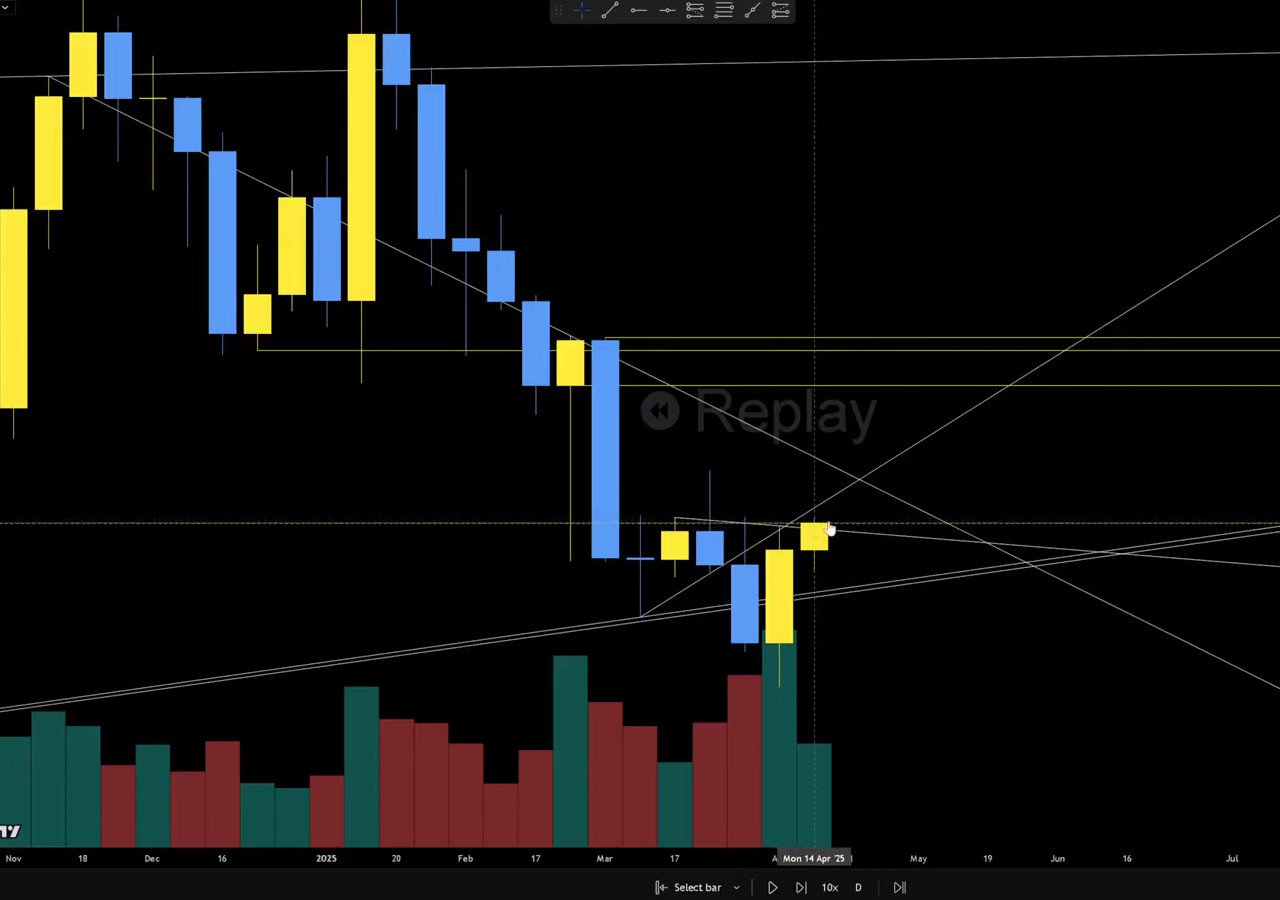
The thesis: averaging only works if every add lands on a real structural level — otherwise you're just paying more to be wrong twice. This walkthrough is the rule that turns "averaging" into a plan, not a panic response.
You shorted at the right level. Then price kept going up. Now what? The structured way to add to a short — only at specific structural levels, never in between. The discipline that distinguishes "averaging" from "averaging down into a margin call."
Source: Video 41Asset: SOLTF: Daily / WeeklySetup: Short with structured averaging
The cost of averaging — make this concrete
Even a winning averaged trade pays less per dollar of risk than the original entry alone would have. Concrete:
Scenario
Avg entry
Stop
Stop distance
P/L at TP1 ($193)
Original short alone (1×)
$167.9
$182
$14.1
+$25.1 / 1.78R
Averaged 3× stack
~$172.15
$182
$9.85
+$60.5 abs · 2.04R/unit
⚠️ Correction — the $182 stop above is not from this trade.
V41 gives two prices, $167.9 and $176.4, and no stop price at all. The 182 comes from a different video and a different (long) trade — V43 @ 06:43, "let's go to say 182, we'll go sort of halfway in between the two ranges". Treat the table as an illustrative reconstruction, not sourced numbers; the shape of the comparison holds, the specific figures do not.
What V41 actually prescribes is a condition, not a price: "get out of the trade if the plan becomes invalidated, and the moment something like a break level is invalid or the moment a break level is hit, you should consider the trade as invalidated" (V41 @ 12:34).
The stack pays more in absolute dollars per unit — but per-dollar-of-risk it's only marginally better, AND every adverse tick now hurts 3×. Failure mode: if the trade fails (a close beyond the originating range's break), the original short's stop-out costs 1R; the stack's costs ~3R. The discipline punishes indiscipline 3× — that's the bargain you're signing for the absolute-$ upside.
Setup
Initial short trigger: hold candle rejection at ~167.9. TPs in mind:
4-hour break (high confidence)
Weekly origin and range trend below (higher confidence)
Stop strategy: AT the break level of the originating range — not above. Tight enough to be efficient, but outside the range itself.
       ┌──────────────────────────────────┐
       │ Initial short fills              │
       └──────────────┬───────────────────┘
                      ▼
       ┌──────────────────────────────────────┐
       │ Price retraces — to a NEW level?     │
       │ (NOT just into the red)              │
       └──────────────┬───────────────────────┘
            ┌── no ───┴── yes ──┐
            ▼                     ▼
       HOLD — no add     ┌─────────────────────────────┐
                         │ Is there fresh structure    │
                         │ above? (weekly retest etc.) │
                         └──────────┬──────────────────┘
                          ┌── no ───┴── yes ──┐
                          ▼                     ▼
                    HOLD — no add        ADD #1
                                              │
                                              ▼
                                    (loop: gate at next level → ADD #2)
                                              │
                                              ▼
                                  ┌──────────────────────┐
                                  │ Range break + trend? │
                                  └──────────┬───────────┘
                                   ┌── no ──┴── yes ──┐
                                   ▼                    ▼
                          HOLD + tight TP        Conservative TP
                                                 take it now
                                                 (bigger size,
                                                  smaller tolerance)
Same gate applied recursively. Each add must justify itself against a NEW structural level — not against your average price. Two adds at the same level = stacking risk, not averaging.
Step 1 · Initial short
First entry
▶
Every later add will be measured against this price — get the original entry wrong and the whole averaging stack inherits a bad anchor.
SOL chart — initial short fires at $167.9 with the stop sitting above the originating range break.
Short at 167.9 on the hold rejection. Stop at the break level of the originating range. Standard FibLab short setup.
Now price moves AGAINST you. Goes to 170. Then 172.
Your call
Add at 170? At 172? Wait? Cut?
Decision
Don't add. Don't cut. Wait.
Reason: 170 and 172 are not structural levels. They're just "the price kept going." Adding here is cope-trading. Stop hasn't hit. Thesis hasn't broken.
"Anything between those points just there's no point adding. It's all just noise."
— Syndotc · Video 41
Step 2 · Add at structure #1
Weekly retest area
▶
"Price went up, I'll add more" is averaging down with extra steps — the only legal add is one that lands on the next structurally-distinct level above the entry.
Second entry stacks above the first at the weekly retest level — averaging only where a fresh trade would also fire.
Price keeps moving up. Hits the weekly retest area at 176.4 — a structural level (a new origin formed there).
Your call
Add here?
Decision
Add at 176.4. This is a structural level — weekly retest area, new origin formation. Average price improves.
This is the difference between disciplined averaging and revenge trading. You're adding at a level you'd take a fresh trade off, not at "the price went up another $3."
Step 3 · Range break + range trend
Watching the structure unfold
▶
Two adds at the same level is stacking risk, not averaging — this add is only legal because a structurally distinct range trend lives above the last one.
Three structural entries stacked, hugging the range break. Size triples; tolerance shrinks.
Range trend rejects → moves to break level → broken → close back below the range. The short thesis is now fully validated. Profit zone.
Your call
Three stacked shorts, average ~$173. Move is on. Where do you take profit first?
Decision
TP on a conservative trend retest first. Lock in the position you've built up.
"Take greediest entries, take conservative profits." After three entries, you don't need to maximize the final TP — banking partial near the first proven structural retest is the right call. Let the residual run if you want.
Failure mode
If the trade goes wrong
▶
The stop on a stacked short has to hold the entire averaged position, not just the last add — averaging discipline cuts both ways, and the exit is the side that punishes the indiscipline.
Failure path: a close above the range break invalidates the short. Discipline cuts both ways — exit, don't add.
Price hard-closes above the range break. Three open shorts. What are the two rules?
If the short fails entirely
Price closes ABOVE the range break (failed short)? Exit. Treat as a new trade.
Already averaged-in? Close at the first profitable retest. Don't wait for the big TP — your size is now larger and your tolerance for further drawdown is smaller.
Discipline cuts both ways. You add at structure when winning, and you cut at the first profitable exit when the thesis is shaky.
Lesson
The averaging rules
▶
Even a winning averaged trade pays less than the original entry alone would have — the rules exist to keep the discount honest, not to pretend averaging is free.
The whole trade as one picture: stop above the range, three entries stacked at structure, captured edge from average price down to TP1.